

COP31: LACK OF AGREEMENT DIDN’T MEAN LACK OF ACTION
The 31st United Nations Climate Change Conference (COP31), held in Antalya, Türkiye, from 9 to 22 November 2026, ended without agreement on its principal negotiating document, the proposed Antalya Pact.
It was the first time that a COP summit had failed to adopt an overarching agreement since Copenhagen in 2009. But that doesn’t mean that nothing was achieved. Several narrower agreements were adopted, while governments and international organisations announced additional voluntary initiatives.
Failure: fossil fuels
The most contentious issue was the absence of any reference to transitioning away from fossil fuels in the proposed final agreement. This was particularly controversial because the 2023 COP28 agreement in Dubai had already established the principle of transitioning away from fossil fuels in energy systems.
The European Union, UK and several climate-vulnerable countries refused to endorse a text that they believed weakened earlier commitments. Oil-producing countries, including Saudi Arabia and Russia, resisted stronger fossil-fuel language. The resulting deadlock prevented adoption of the Antalya Pact.
Failure: financial settlements
Finance remained another major obstacle. Developing countries sought clearer commitments from wealthier nations to help fund emissions reductions, adaptation and responses to climate-related damage.
A proposal to triple adaptation finance lacked an agreed baseline against which that increase could be measured. Without a clear starting figure, timetable and reliable delivery arrangements, critics argued that the commitment would be difficult to assess or enforce.
Failure: emissions-reduction commitments
COP31 did not deliver the additional collective action needed to close the gap between current national climate plans and the Paris Agreement’s objective of limiting global warming to 1.5°C above pre-industrial levels.
Proposed decisions on the Mitigation Work Programme also failed to secure agreement. Consequently, the summit produced no new overarching framework for accelerating emissions reductions.
Failure: carbon capture
Proposed language supporting carbon capture, utilisation and storage proved controversial. Some countries regard these technologies as important for reducing emissions from difficult-to-decarbonise industries. Others fear that an excessive reliance on them could provide justification for continuing fossil-fuel production rather than reducing dependence on coal, oil and gas.
These disagreements contributed to the rejection of the proposed final text.
Positive: progress on climate adaptation
Countries adopted decisions concerning the Global Goal on Adaptation and the Adaptation Fund. These are important mechanisms for helping vulnerable countries prepare for rising temperatures, floods, droughts and other climate-related threats.
Although the larger financial questions remained unresolved, the agreements preserved momentum on adaptation planning and support.
Positive: new international electrification initiative
Nearly 100 countries supported a voluntary initiative to increase electricity’s share of global final energy consumption to 35% by 2035. The aim is to accelerate the replacement of fossil-fuel technologies with cleaner electric alternatives, particularly in transport, heating and industry.
The UK endorsed this initiative, known as the 35×35 Global Electrification Pledge. It is a potentially significant development, although its effectiveness will depend on national implementation and the availability of low-carbon electricity.
Positive: progress on methane emissions
New partnerships and commitments addressed methane, a particularly potent greenhouse gas. Initiatives included efforts to reduce methane emissions associated with fossil-fuel production and a UK–Nigeria partnership focused on low-methane development.
These commitments are voluntary, but reducing methane emissions can deliver relatively rapid climate benefits compared with measures targeting carbon dioxide alone.
Positive: forests, oceans and biodiversity
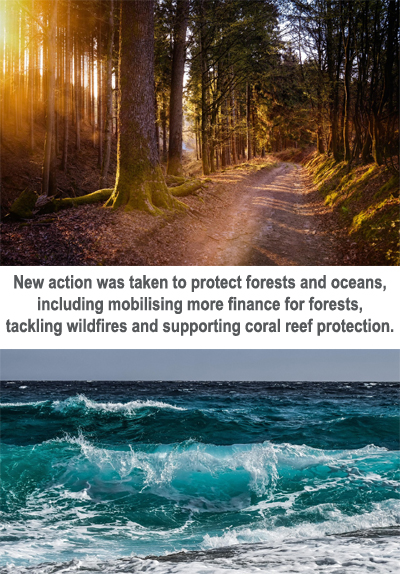
The conference provided a platform for new initiatives addressing forest conservation, wildfire prevention, ocean protection and coral reef preservation. These included efforts to mobilise additional conservation finance.
Although these initiatives were not substitutes for a comprehensive climate agreement, they demonstrated that international cooperation on specific environmental challenges could continue despite wider political disagreements.
Positive: continuing work on a just transition
Countries adopted an outcome under the Just Transition Work Programme, which addresses the social and economic consequences of moving towards low-carbon economies.
This is particularly relevant to developing countries concerned that climate policies could impose disproportionate costs on workers, communities and economies still dependent on fossil fuels.
Summary
Perhaps the most important distinction is between the failure of the negotiations and the continuing operation of international climate agreements.
The collapse of the Antalya Pact does not invalidate the Paris Agreement or cancel existing national commitments. Those obligations and commitments remain in place.
There is also a wider historical perspective. Before the Paris Agreement, projections suggested the world could experience approximately 4°C of warming by the end of the century. Current national commitments suggest a trajectory closer to 2.6–2.8°C, depending on the assumptions used. This remains substantially above the Paris target, but it demonstrates that international climate cooperation has coincided with meaningful changes in policy and investment.
The immediate consequence of COP31 is that several difficult decisions have been deferred to COP32, scheduled for Ethiopia in 2027.
COP31 exposed the continuing divide between countries seeking an accelerated transition away from fossil fuels, those concerned about the economic consequences of that transition, and developing nations demanding greater financial support.
The absence of an overarching agreement was a substantial diplomatic setback. Nevertheless, the adoption of narrower decisions on adaptation and just transition, alongside voluntary initiatives on electrification, methane and conservation, demonstrated that cooperation remains possible even when consensus on the central issues proves elusive.
One potentially positive interpretation is that countries refusing to accept a weakened agreement helped preserve the commitments made at previous conferences. The alternative interpretation is that rejecting the compromise left the world without an agreed new collective response at a time when emissions reductions are increasingly urgent.