
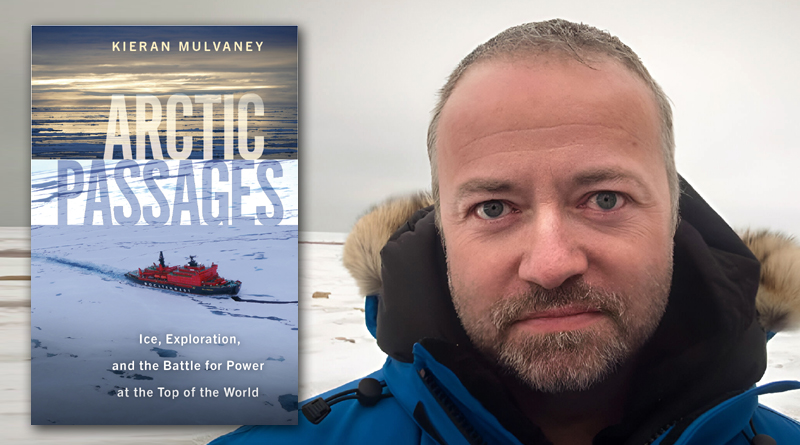
ARCTIC PASSAGES – NEW BOOK
In his new book, Kieran Mulvaney reminds us that while we go about our lives, climate change is unspooling slowly but insidiously, spawning extreme weather events that will be increasingly difficult to ignore. Here’s an excerpt:
Arctic Passages: Ice, Exploration, and the Battle for Power at the Top of the World
by Kieran Mulvaney
Excerpt from pages 21-24
There are several reasons why the Arctic should be especially prone to warming. The “weather layer” of the atmosphere known as the troposphere is thinner above the poles than at the equator and so requires less energy to create a given amount of warming. Additionally, in the humid tropics, a sizable proportion of the Sun’s energy is expended on evaporation; in the dry air of the Arctic, that energy leads directly to heating. And the Arctic contains a number of feedback mechanisms that exacerbate warming, primarily in the form of what is known as albedo: snow and ice cover in the polar regions reflects sunlight, meaning that those areas have a high albedo, but as that snow and ice melts, it exposes darker rock and water underneath, which absorbs more heat, prompting more heating and further melt.
Since 2007, the National Oceanic and Atmospheric Administration (NOAA) has been documenting observed year-on-year changes in the Arctic environment in an annual Arctic Report Card. Some of the more recent and notable documented impacts of increased Arctic temperatures: record low June snow cover in Siberia; extensive wildfires in northern Russia; “browning” of the tundra in North America; rainfall on the Greenland ice sheet; thawing permafrost that damages infrastructure and, in turn, releases additional stores of carbon into the atmosphere. But arguably the most visible, dramatic, and easy-to-comprehend change is in the extent of Arctic sea ice.
From mid-September until mid- to late March, Arctic sea ice steadily expands in area before decreasing with the return of warmer weather and longer days until it reaches its minimum extent and the cycle begins anew. Since 1979, microwave sensors on satellites have provided uninterrupted imagery of Arctic sea ice, and from the earliest years of analysis, there has been evidence that the extent of that sea ice was in decline. Initially, however, that decline was halting; for the first dozen or so years of observation, low summer ice coverage would be followed by a return to average, or near average, conditions in the winter. That changed in 2002, when the September sea ice minimum fell to a record low of 2.3 million square miles, more than 400,000 square miles below the 1979–2000 average and almost 66,000 square miles less than the previous record low. The next few years saw a mild rebound, another fall in 2005, and then, in 2007, a collapse.
That year, a confluence of atmospheric conditions laid waste to an ice cap that had not recovered strongly from the previous summer. The result was a September minimum sea ice extent of 1.65 million square miles, 23 percent lower than the previous low and 39 percent lower than the average during the satellite era. “Huge chunks of ice were missing,” Mark Serreze, director of the National Snow and Ice Data Center, later wrote. He described viewing the collapse with “a sense of morbid fascination…. I had never seen anything like this before.” In an interview with the Washington Post thirteen years later, he described that year as “the beginning of the ‘new Arctic.’ Since 2007 it [has] been one piece of bad news after another.”
As epochal as 2007 was, it would soon be surpassed. The year 2012 usurped its position as having the lowest sea ice minimum on record, and 2020 slotted into second place, while 2016 and 2019 would join 2007 in a statistical tie. As of July 2024, the seventeen lowest Arctic sea ice years were the seventeen most recent Arctic Sea ice years.
Serreze has described Arctic sea ice as being in a death spiral as more Arctic warming begets further Arctic melting, which facilitates additional warming and yet more melting, the process potentially continuing absent correction until the cycle may be unstoppable.
(Although similar, “area” and “extent” are not quite the same. Area is the total amount of surface covered by sea ice; extent is the entire space within the outer boundary of sea ice coverage, including areas of open water. In the words of the National Snow and Ice Data Center, “A simplified way to think of extent versus area is to imagine a slice of Swiss cheese. Extent would be a measure of the edges of the slice of cheese and all of the space inside it. Area would be the measure of where there is cheese only, not including the holes.”)
While much focus is on the declines in Arctic sea ice area or extent, of arguably greater import is the even more dramatic decline in sea ice volume— and, at the same time, in its age.
Look at a graphic of Arctic sea ice extent over the course of a year and two things become immediately evident: there is, unsurprisingly, far more ice in winter than in summer; but there is some degree of sea ice coverage year-round. Some of the ice that forms in winter, in other words, persists through the following summer and into the following fall, and some of that ice survives yet further, into a third year or even beyond. And the longer sea ice lasts, the more likely it is to continue to last because with each successive winter, it becomes progressively thicker: while first-year ice may be just a few feet thick, so-called multiyear ice can extend to a depth as great as fifteen feet. But increasing temperatures not only prevent ever-larger amounts of fresh ice from surviving into a second year; they also chip away at the older ice, reducing overall sea ice cover not only in extent but also in thickness and thus volume. According to data compiled by the Polar Science Center at the University of Washington, average Arctic sea ice volume in November has fallen from 4,828 cubic miles (mi3) in 1979 to 3,781 mi3 in 2001 and 2,254 mi3 in 2021. According to the National Snow and Ice Data Center, the amount of multiyear ice coverage in the Arctic declined from 61 percent in 1984 to just 34 percent in 2018, and just 2 percent was composed of the thickest, oldest ice that had persisted for five years or longer—raising the prospect, said Serreze, of a future in which multiyear ice could effectively cease to exist and “sea ice will be but a seasonal feature of the Arctic Ocean.”
That would matter for multiple reasons. Species such as polar bears that live and hunt on the surface of the sea ice would be most immediately and obviously at risk of depletion in, or extirpation from, those regions where their habitat was but a temporary feature; so, too, the ice-dependent species on which they prey. Thinning or absent ice, and any consequent alteration in the finely balanced timeline of ice melt and growth, could have comprehensive and complex consequences for the entire Arctic marine ecosystem to an extent that scientists are only beginning to unravel. For the people who live and subsist in the Arctic, and for whom sea ice is not just integral but fundamental to their history, culture, and survival, the changes would be profound, threatening the existence of a way of life that has thrived for millennia. Although the evidence remains inconclusive, declining Arctic sea ice may also have significant impacts on climatic conditions in lower latitudes as warmer temperatures disrupt oceanic and atmospheric circulation patterns.
And yet, where many see disruption and challenges, others sense opportunity, and not just in the opening of possible trade routes. In 2007, a Russian submarine planted a titanium flag on the seabed at the North Pole, and in October 2019, Russia’s ministry of defense proclaimed that it had collected enough evidence to support a territorial claim to much of the Arctic Ocean. Canada has exerted a counterclaim, while Denmark has laid down its own metaphorical marker, based on the fact that a large area up to and beyond the North Pole is connected to the continental shelf of Greenland.
Some observers worry about the impact of increased traffic and development on wildlife and the environment, in the form of increased noise and development and the potential for accidents, oil spills, and pollution. Others envisage a scenario in which regional development and economic growth empower and enrich the peoples of the North. Some see competition, the emergence of a truly cold war as great powers jostle over issues of access and territory. The United States military reportedly frets about an “icebreaker gap”; defense think tanks compare growing tensions in the Arctic to those in the South China Sea; and the first Donald Trump administration clumsily declared a desire to purchase Greenland and responded in a huff when the notion was airily dismissed by Denmark. Yet there is a case to be made that such conjecture is overwrought and overblown, particularly given the existence of established treaties that promote a history of cooperation within the Arctic and the fact that Arctic nations are merely conducting due diligence in anticipation of the region ultimately becoming at least seasonally ice free.
What is clear, however, is that absent steps to address climate change, the Arctic will undergo significant change in the coming decades. Indeed, it is already doing so, to an extent that the Arctic of today would in many ways be barely recognizable, both to those who first searched for passages through its frozen waterways and to those whose presence preceded them by centuries.
ABOUT THE AUTHOR
Kieran Mulvaney is the author of At the Ends of the Earth: A History of the Polar Regions, The Whaling Season: An Inside Account of the Struggle to Stop Commercial Whaling, and The Great White Bear: A Natural and Unnatural History of the Polar Bear. A regular contributor to National Geographic, he has also written for The Guardian, The Washington Post Magazine, BBC Wildlife, New Scientist, E Magazine, and other publications. Born in England, he spent several years living in a cabin in Alaska and visits the Arctic and subarctic regularly. He now lives in rural Vermont.
Published by Island Press: https://islandpress.org/books/arctic-passages
Permission: Arctic Passages by Kieran Mulvaney. Copyright © 2025 Kieran Mulvaney. Reproduced by permission of Island Press, Washington, D.C.